Unstable synchronisation
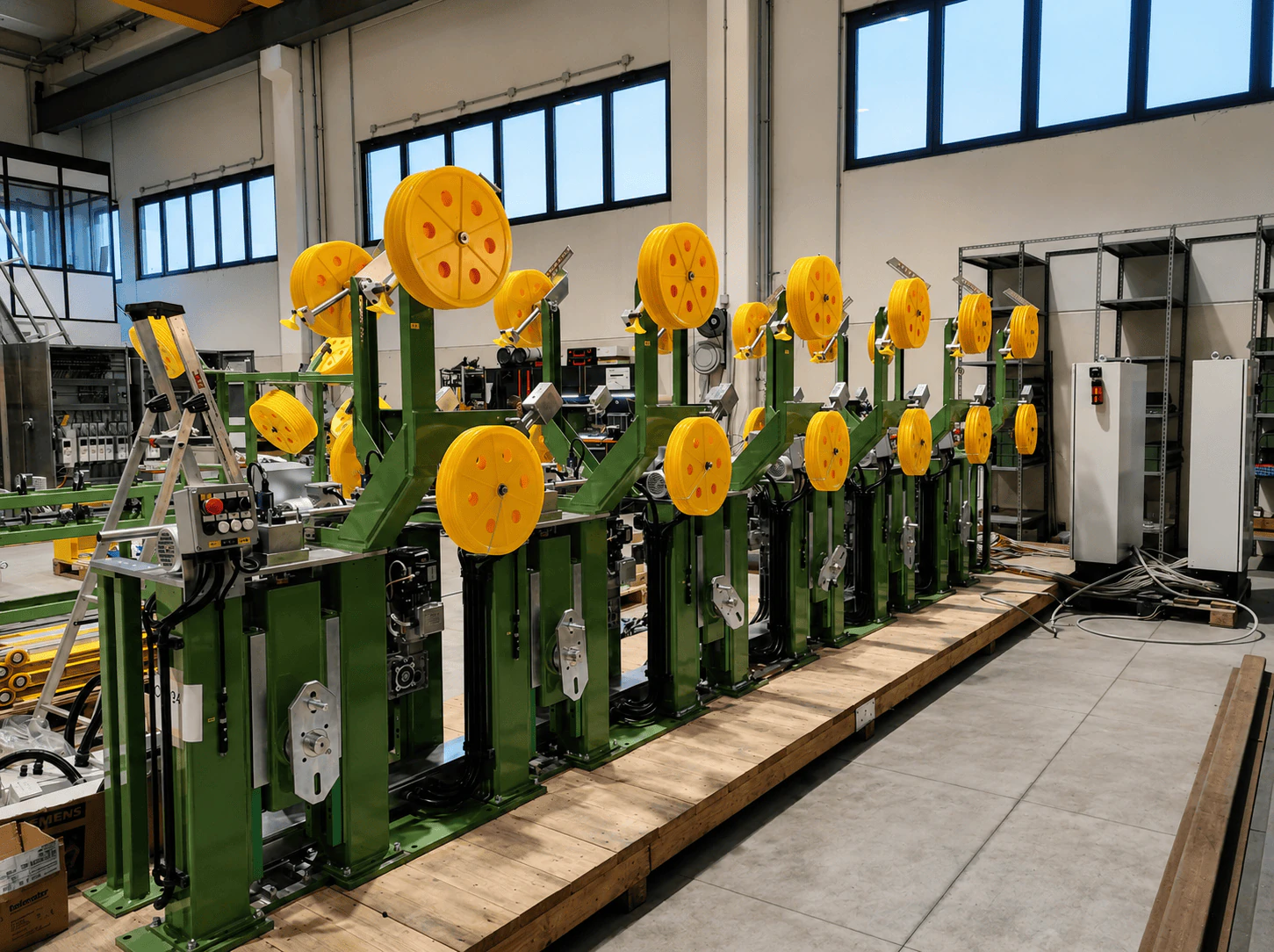
Speed, capstans, dancers and winders have to react together, without constant corrections from the operator.
Industrial sector
Panels, machine side, PLC/HMI/SCADA software and start-up for lines where tension, synchronisation and reel history must stay under control even on 24/7 cycles.
What we solve
When a cable line slows down, the problem is rarely a single component: you need consistent signals, clear logic and data that is useful to the people running the line.
Speed, capstans, dancers and winders have to react together, without constant corrections from the operator.
Alarms, trends and line states help understand whether scrap comes from tension, temperature, recipe or the start-up phase.
Batch, parameters, progress and anomalies must be reconstructable without parallel spreadsheets or manual steps.
FAT, tested sequences and documentation reduce surprises when the plant enters production.
Related services
From the electrical schematic to the software, from the panel to start-up: every service has a clear scope and stays coordinated with the others.

Schematics, BOMs and panel architectures for extrusion, drawing and winding lines.

Line synchronisation, operator interfaces, diagnostics and traceable reel data.

Tidy wiring, traceable components and electrical tests before delivery.

Signal tests, proven sequences and commissioning of the line in production.
From field to data
D&D connects sensors, panel, drives, PLC and supervision into a readable chain. The goal is to know what is happening on the line before it becomes downtime or scrap.
The line isn't seen as a sum of machines, but as one continuous system: field, panel, software and operator must speak the same language.
Survey of critical signals, machine conditions, field networks and operating constraints.
Electrical schematic, I/O, drives and components organised for testing and maintenance.
Sequences, recipes, alarms, trends and operator pages built around the process.
Functional tests, checks with the customer and field support through to production.
Typical applications
Each sector page goes into the detail of the areas where D&D can bring electrical, software, testing and operational support.
Control of temperatures, speed, enables and line recipes.
Tension management, synchronisation and transitions between modules.
Logic for diameters, layering, reel change and traceability.
Integration of signals, instruments and quality data.
PLC/HMI migration and panel upgrade with planned downtime.
Reel history, recipes, alarms, trends and operational reports.
D&D method
On cable lines you don't need a generic solution. You need a technical reading of constraints, signals, downtime, operators and real goals.
We collect documentation, plant status, recurring problems and the expected result.
Panel, PLC, HMI and supervision are designed as one operating system.
Critical functions are tested to reduce the risk at start-up.
The final step is making the solution usable by operators and maintenance.
Related experience
Concrete references to understand how D&D translates the sector into automation, panel, software and testing.
Automation and control for an operating system aboard the Prysmian Group vessel.
A new real plant from this sector will be online soon, with context and results.
Operational questions
Yes. First we gather the schematic, installed PLC/HMI, symptoms and downtime constraints; then we define an intervention compatible with production, testing and restart.
Yes. The value lies precisely in coordinating field signals, drives, PLC logic and HMI, avoiding disconnected adjustments between modules.
Not always. Early on we separate what should be kept, what should be migrated and what is worth rebuilding for reliability, safety or maintenance.
Useful items are the line layout, PLC/HMI brand, electrical schematics, a description of downtime or scrap and the expected goal: new line, revamping, diagnostics or supervision.
Technical contact
You don't need a complete specification. The sector, machine or line, goal and main constraints are enough: your request reaches the D&D technical team already in context.