

Fiber-optic towers
Five gases, one furnace, two floors.
Twin towers: gases, furnace and axes to watch all at once. Panels, machine-side wiring and operator screens are ours.
Read the case study →Special machines · since 1996
Electrical design, PLC/HMI software, control panel and testing are ours. The mechanics are built by selected partners, and we coordinate them. You deal with one company.
Technical reply in 1–2 business days · No commitment
How the first request almost always sounds
“I need a machine that
picks up the part,
processes it, checks it
and turns out
forty a minute.
It’s not in any catalog.”
Companies that have trusted us





Scope of supply
We are not steel fabricators and we don’t pretend to be.

Built by partner companies we have worked with for years, to the constraints we set.
Schematics, line-side panel, wiring: designed, built and tested by us, in Mesero.
PLC and operator screens: sequences, recipes, alarms written for whoever is on shift.
FAT at our shop, SAT on site, start-up and operator training.
Tube line, in the D&D workshop in Mesero before delivery. Read the case study →
The boundary can move — your contact doesn’t.
The brief, technical interfaces, checks and testing stay with us, even for the part we don’t build.
One point of contact
On a machine put together by four different suppliers, the first half hour isn’t spent getting it running again. It’s spent working out whose problem it is.
“The unit moves. If the cycle won’t start, that’s not on us.”
The mechanical builderAsk whoever wrote the software.
“The program does what it’s told. And the enable never comes.”
The software developerIt’s a signal problem: ask the panel builder.
“There’s voltage at the panel. We didn’t fit that sensor.”
The panel builderAsk whoever did the field installation.
“Installed as drawn. If the drawing is wrong, ask them.”
The installerAsk the mechanical builder.
And back to the first one. Meanwhile, the line is down.
Electrical, software, panel and testing are ours: there is no one to pass the question to. If the machine isn’t producing, it’s our problem — even for the mechanics a partner built.
Before the steel
Before a single part is cut, the whole machine is already written. That’s where we catch the mistakes that would cost weeks on the shop floor.

A real job set, tagged and under revision control. It’s what maintenance will be reading ten years from now.

Process overview, recipes, alarms with history. The night shift has to understand it on its own.

Real jobs
No renderings: two systems that left our workshop, photographed on site.
Twin towers: gases, furnace and axes to watch all at once. Panels, machine-side wiring and operator screens are ours.
Read the case study →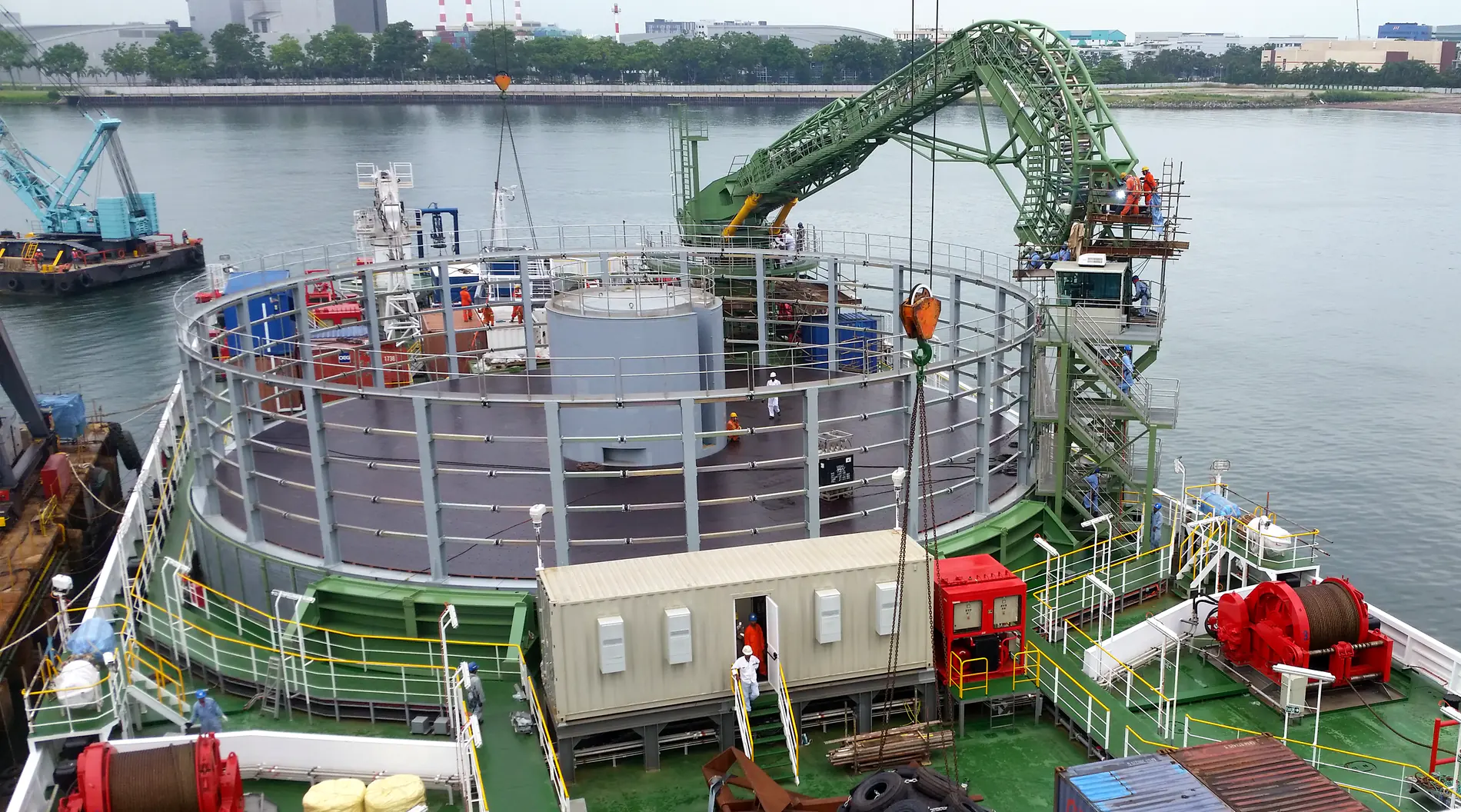
A carousel 36 meters across, caterpillar, crane and winches work the cable as it goes down to the sea. The automation that keeps them in step is ours.
Read the case study →The service
The part you don’t see in the quote: what you have in hand the day after start-up, and who answers when you call.
The handover
They serve whoever maintains the machine, even if that isn’t us: a machine only we can touch is not a good deal for you.
12 months of support. Included.
Call when you need to, without wondering what the question costs. It matters most in the first months, when real production brings out what nothing else can.
Panel, hardware and software answer to one company. If something goes wrong, it’s not your job to work out whose fault it is.
For our customers, every day. +39 02 97289083
If the machine has secure, authorized remote access, from Mesero we see the same screen the operator sees: many checks take half an hour instead of a trip. How our remote support works
Frequently asked questions
The mechanical part is built by selected partner companies, coordinated by us. You don’t manage two suppliers: the brief, the technical interfaces and the checks stay with D&D, your single point of contact.
It depends on the job, and it is decided at the start. If we are the machine manufacturer, the CE marking is ours; if it is the customer or the mechanical builder, we deliver the electrical part with all its documentation. From January 20, 2027 the new EU Machinery Regulation 2023/1230 applies: being clear about who the manufacturer is matters even more.
Yes. Many jobs start that way: completing a missing technical block, redoing the automation, replacing an obsolete panel or picking up a project that stalled.
The result you want and a few facts: the product to process, the expected cycle or output, the space available. Drawings, photos or a concept diagram help, but you don’t need them to start.
It depends on the scope. After the analysis we give you a realistic schedule by phase — engineering, panel, software, testing — instead of a vague date.
Yes: electrical schematics, panel layout, I/O lists, bills of materials, manuals and software backups. The documentation is yours, and it serves whoever maintains the machine, even if that isn’t us.
We stay available for service, changes and support. Testing ends with an open-items list worked through until the machine is stable, not with a promise.
The first step
You don’t need to know how it’s done, either. With these three answers an engineer can tell whether the machine is viable and what to ask next.
What goes in: the part, the material, the format
What comes out: the result you need
How many: per minute, per hour or per shift
An engineer reads it, and the first reply comes within 1–2 business days.
Not a new machine? If you need to complete a missing block or redo the automation of a machine you already have, the starting point is different: revamping. If you’d rather just talk it over, the number is +39 02 97289083.